


Meet Our Buildings: Laurel Branch & the Out-Kitchen

May is National Preservation Month, celebrated annually to promote historic places, heritage tourism, and the social and economic benefits of preservation.
The Accokeek Foundation supports preservation year-round by also caring for several unique historic structures at Piscataway Park. These buildings are used to teach students and the public about the shared history and heritage of the Southern Maryland region.
Laurel Branch
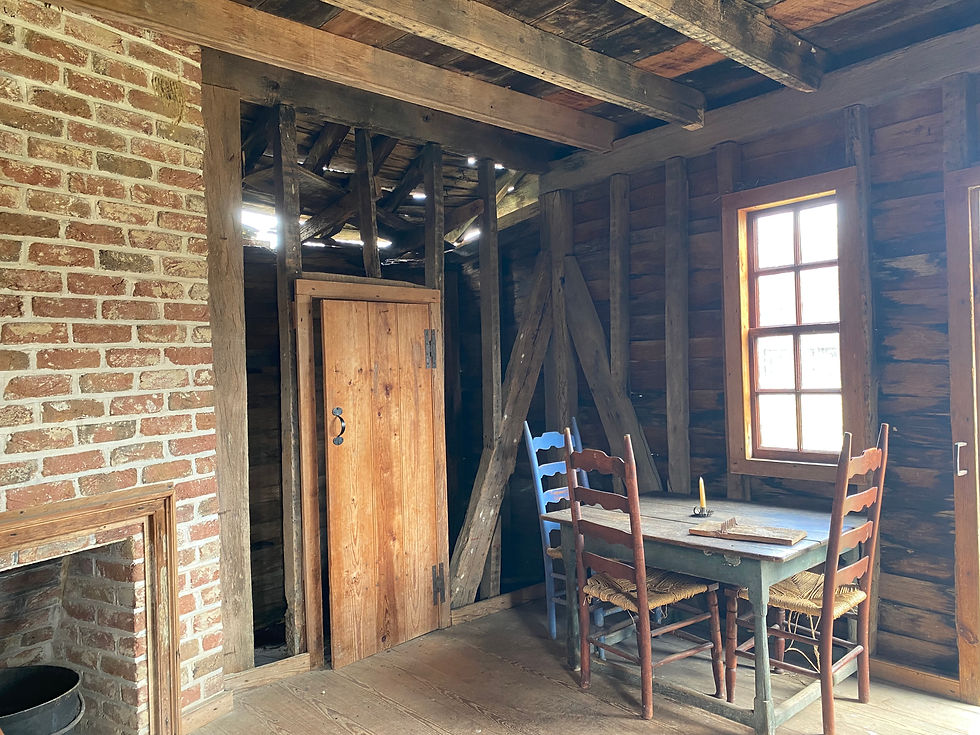
One iconic example is Laurel Branch, the historic farmhouse built around 1770 in what is now Bensville, MD. The building was donated to the Accokeek Foundation by the Phillip family in 1987, then carefully documented, disassembled, and moved to Piscataway Park. Since then, Laurel Branch has been a central part of the Foundation’s educational programming.

At first, Laurel Branch was interpreted as home to the Boltons, a fictional middle-class tobacco farming family situated across the river from George Washington’s Mount Vernon estate. In reality, the land where Piscataway Park now lies was owned by a wealthy landowner and leased to tenant farmers, not owned by a middle-class family. After careful research, the Accokeek Foundation now uses Laurel Branch to tell the story of tenant farmer families – some of them Piscataway – who leased land from large plantation owners in Southern Maryland.
We know that in this area, Piscataway people who were hiding in plain sight, assimilating into the introduction of European culture, could and did become tenant farmers on the land their people called home. Our evolving interpretation of Laurel Branch allows us to tell a more expansive story of this land and the people who have lived and worked on it for generations.

Out-Kitchen
Outside of Laurel Branch is the Out-Kitchen, a replica built in the 2000s to resemble historic out-kitchens. Around three-quarters of homes in the region would have had an out-kitchen like the one at Piscataway Park. The kitchen was detached from the house for several reasons. Keeping cooking away from the main house would help keep the inside of the house cool and comfortable in the summertime, something especially important in the humid Southern Maryland summers. However, kitchens were not moved to separate buildings until the 18th century, with the rise of chattel slavery. Out-kitchens provided a more rigid separation between the enslaved and the enslavers, making them a popular feature of many homes at the time.

Historic structures like Laurel Branch and the Out-Kitchen are fragile and require constant maintenance and repair. In 2025, the Accokeek Foundation received funding from the Maryland Heritage Areas Authority (MHAA) to restore the out-kitchen at Piscataway Park, improving its structural integrity and historical accuracy.
Thanks to our heritage area partner, Anacostia Trails Heritage Area, and funding support from MHAA and Preservation Maryland, the Accokeek Foundation can continue to care for these historic structures and the unique stories that they preserve. You can become a part of the preservation story of Piscataway Park by becoming a member of our sustaining gifts program, which supports the Accokeek Foundation's preservation work.
This project has been financed in part with State funds from the Maryland Heritage Areas Authority but does not necessarily reflect its views or policies.


